Gods and Goddesses of Ancient Egypt Really Cool Cultural Art Africa
Organized religion
Throughout Arab republic of egypt'south history beliefs and practices were constantly irresolute though the themes of fertility, rebirth, decease and resurrection by and large remained constant. The ancient Egyptians had a tendency to merge new beliefs with the onetime ones rather than simply replace them. This tendency has made information technology difficult for modern scholars to fully understand the ancient beliefs and, although much is known, there is still much that remains a mystery.
Stay in the know
Proceed in touch and feel our cultural programs and educational offerings, many of which are community inspired and led.
Subscribe now
Gods
We know of hundreds of gods and goddesses worshipped by the ancient Egyptians equally their names, personalities and appearances have survived in the artwork the civilisation left backside. Many of these had the aforementioned or like roles. This is due to both the circuitous nature of the organized religion and the political arrangement of the state.
Local areas had local gods, with each city or region oft having their own deities that they worshipped. If a city came to prominence under a ruler or powerful official, then the local gods rose alongside them. These became 'country' gods, worshipped by the wealthy and elite in the temples. However, the full general population continued to worship their local gods as well. Some gods, therefore, were preferred by sure classes of people, some were only worshipped in certain areas, and others prominent only in certain periods. In later times, different deities were frequently combined or merged.
Osiris, chief god of the expressionless and the afterlife, is usually depicted every bit a mummy-shaped human wearing the atef crown (a white crown flanked by ostrich feathers) and property a crook and a flail (signs of kingship and justice) Occasionally, Osiris' peel is green or black, a reference to his aspects of vegetation and fertile earth.
3D interactive model of limestone statue of Osiris
View the limestone effigy of Osiris on Pedestal 3D for full screen and additional functions.
Anubis was the jackal-headed god of embalming and mummification and the patron god of embalmers. He was besides a guardian of the dead and a guide through the underworld.

Figure of Anubis. Jackal head, human body. Epitome: Abram Powell
© Australian Museum
Neith was the mother of the sun god Re and a goddess of hunting and warfare.
The dwarf Bes was a pop household god and mainly responsible for protecting the family unit and ensuring a safe childbirth in particular. Artists often depicted him facing forward, rather than in profile.
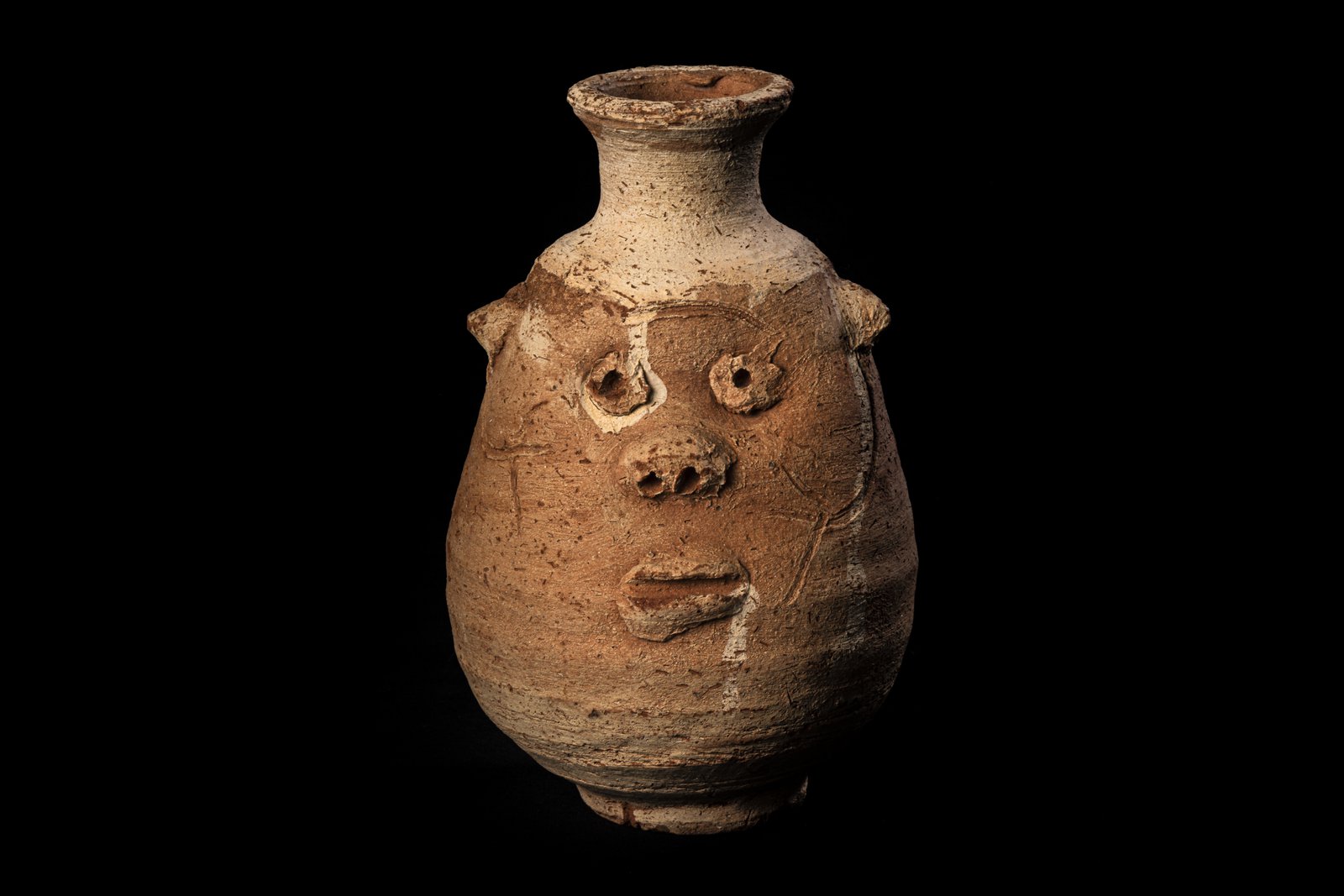
Ceramic. 16cm high. 10cm across at widest betoken. Egyptian c 1990 BC - 1080 BC Provence: Esna, Egypt Bes was a mutual deity depicted on pottery throughout Egyptian history. He was portrayed as curt and ugly, with his face and tail resembling a lion. Because children were not judgemental of his appearance he became the protector god of children. Epitome: Abram Powell
© Australian Museum
Sakhmet was goddess of war, destruction and misfortune. The name is derived from the ancient Egyptian discussion sekhem, meaning 'powerful'. She is an aggressive deity who is usually depicted as a king of beasts-headed figure.
The cat-headed goddess Bastet was the gentle counterpart to the lion-headed Sakhmet. She was protector of the home and pregnant women and was also linked to worship of the moon.
Horus, the falcon-headed sky god, was the son of Osiris and Isis and the embodiment of divine kingship. His eye, or udjat (sometimes spelt wedjat), was a powerful protective amulet. Rulers of Egypt were considered to be earthly representations of Horus so many falcon statues and images bear the crown of Upper and Lower Egypt.

Earthenware amulet depicting the middle of Horus, son of Egyptian deities Osiris and Isis. From a site near Defenneh in Lower Egypt. Acquired in 1911 via the Egypt Exploration Fund. Size: approx. 5.three 10 iv cm. Image: Stan Florek
© Australian Museum
Man-headed Imsety, a son of Horus, was the protector of the liver.
Baboon-headed Hapy, a son of Horus, was the guardian of the lungs.
Falcon-headed Qebehsenuef, a son of Horus, protector of the intestines.
Jackal-headed Duamutef, a son of Horus, keeper of the stomach.

Duamutef was one of the four sons of Horus, guardians of the deceased king'south organs. This jackal-headed god protected the king's stomach and shielded him from impairment in the Netherworld. The ancient Egyptians feared death and decay and protected the deceased by removing the organs and mummifying the trunk.
Image: Laboratoriorosso, Viterbo/Italian republic
© Laboratoriorosso, Viterbo/Italy
Thoth, a moon-god, was the god of wisdom, maker of laws and chief scribe to the gods. He was also a guide and helper to the spirits of dead people travelling in the underworld. Artists depicted him as an ibis, a baboon or a man with the caput of either of these animals.
Isis was the wife-sister of Osiris and a powerful goddess of protection.
Nephthys was the sister of Isis and Osiris and a protector of the dead.
espinozasunitoomas.blogspot.com
Source: https://australian.museum/learn/cultures/international-collection/ancient-egyptian/religion-and-gods-in-ancient-egypt/
0 Response to "Gods and Goddesses of Ancient Egypt Really Cool Cultural Art Africa"
Postar um comentário